
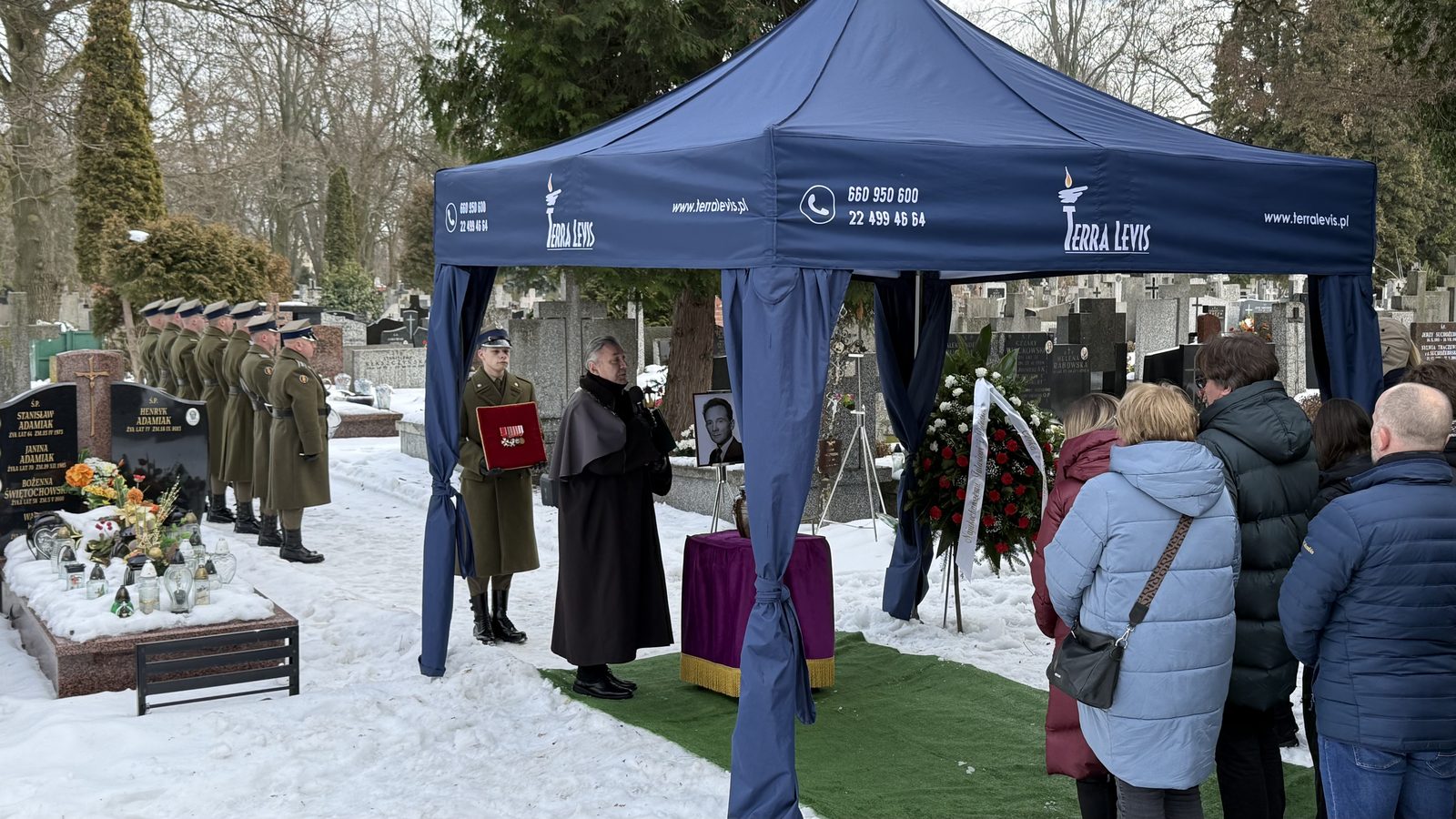
A secular funeral does not take place in a church. The service is led by a master of ceremonies - usually at the funeral home, at a municipal cemetery or at the graveside. The ceremony focuses on the life and memory of the deceased; it can also be combined with a religious rite. We arrange secular funerals in Warsaw. Tel. 660 950 600.
“Does a secular funeral take place in a church?” - this is a question often asked by people considering this form of burial. Some of us would like a funeral in a place of worship; on the other hand, secular funerals have long been associated with a solemn atmosphere, moving speeches and a focus on gratitude for the life of the deceased. However, as the name suggests, a secular funeral has no religious elements. It is a ceremony led not by a priest but by a master of ceremonies, usually held at a funeral home, at a municipal cemetery or at the graveside of the deceased. Although a secular funeral is not held in a church, it is becoming increasingly popular. This is a natural result of the growing number of non-religious people who, following their own conscience, wish to remain true to their convictions. What is worth knowing about a secular funeral, how does it proceed and why do many of us consider it a special ceremony?
How does a secular funeral ceremony proceed?
Because a secular funeral does not include a mass or a church service, it follows a slightly different course than a Catholic ceremony (or one connected with any other faith). The first stage is usually the farewell to the deceased at the funeral home. It is a time for reflection, for listening together to music the deceased liked, for viewing a presentation and films from their life, and for family members or friends to speak. It is a moment when tears often flow - both from emotion and from deep gratitude for the time we were given with the deceased. The second stage takes place at the graveside. This is when flowers are laid and thanks are given to those attending. Depending on the family's preferences, the ceremony may be more elaborate or based on an intimate, private atmosphere. Because the order of the ceremony is agreed with the master of ceremonies, those closest to the deceased need not worry that something important to them and to the deceased will be left out.
A secular funeral - a way to commemorate the deceased
Why are secular funerals attracting growing interest? At Catholic funerals and at those of other denominations one can often hear that the priest focuses not on the life of the deceased but on the course of the ceremony itself. Unlike such funerals, a secular ceremony attaches great importance to focusing precisely on the life of the person who has died. During the address given both by the master of ceremonies and by the family (at their express wish), the most important events of the deceased's life are recalled, the values they lived by, the kind of person they were. As family and friends share their memories, sadness naturally turns into a sense of gratitude: those taking part realise how many good moments they spent with the person who died and how much they learned from them. It is a deeply moving ceremony that does not dwell on sorrow, longing or despair, although these are naturally part of it too, but shows the life of the deceased more widely, with attention to how much that was good happened in that time.
Who is a secular funeral for?
A secular funeral is not only a form of burial chosen, for obvious reasons, by people who do not believe, but also by all those who do not identify with any denomination yet wish to be buried with due respect. A secular funeral is usually chosen by people who do not want a church ceremony and did not take part in one during their lifetime. It also suits those who want a neutral ceremony focused on the life of the deceased and on memories of them rather than on religious rites alone. According to the available statistics, between roughly 16,000 and as many as 25,000 people a year choose this kind of funeral. By comparison, in 2018 there were about 8,000 secular funerals a year. There is no doubt that this trend will grow, among other reasons because of the rising number of people leaving the church and other religious communities.
Can a secular funeral be combined with a Catholic one?
As for the form of burial of the deceased - more and more often we see not only a choice of a secular funeral, but also its combination with a religious ceremony. Although in practice this is not one “joint” funeral - many people first choose a Mass in church or another service connected with their religion, and then the participation of a master of ceremonies at the cemetery. Sometimes we also see a priest taking part in a short religious rite and - next - a master of ceremonies leading a secular ceremony full of memories of the deceased. This kind of compromise suits people who care about the blessing of the coffin or urn - and then about holding the funeral in an atmosphere of calm, gratitude and nostalgia. Although the Catholic Church usually prefers a fully religious form, the mixed form is gradually becoming standard at many cemeteries. When choosing the form of burial, it is worth considering above all what matters most to us - whether we care about religious aspects (for example a prayer at the grave or a reading from Scripture), or about those connected directly with the life we shared with our loved ones and friends.
A secular funeral - a ceremony long remembered
A secular funeral is one of those forms of funeral that families and friends often speak of warmly. It is a funeral remembered long afterwards - with meaningful elements such as photographs, video or music. Because a secular funeral can be arranged from start to finish according to the wishes of the deceased or their family, no two ceremonies are ever the same. Even if writing the eulogy seems daunting, an experienced master of ceremonies will help, capturing everything that mattered most in the life of the deceased. It is a ceremony full of empathy, gratitude and calm - in a way summing up their time with family and friends. Choosing this form of funeral means an occasion that will stay in the memory of your loved ones for a long time, and one that helps turn sorrow and pain into a sense of gratitude and fulfilment.